1. Card Values & Scoring System
In baccarat, tens and face cards (Jacks, Queens, Kings) are worth zero points. Aces count as one point, and numbered cards from two through nine retain their face values.
When cards are totaled, only the single rightmost digit counts (modulo 10). For example, a hand consisting of a seven and an eight totals fifteen, which drops the ten to become a five. A nine and a six total fifteen, resulting in five. The highest possible hand value is nine. If either side receives an eight or a nine on the initial two-card deal, this is termed a "natural" and the round ends immediately without additional cards drawn.
2. The Third Card Drawing Tableau
Unlike blackjack, players never decide whether to hit or stand. Card draws are governed strictly by a fixed procedural tableau mandated by regulatory bodies like the Nevada Gaming Control Board Statutes:
Baccarat Decision Flowchart
3. Commissions vs Non-Commission Tables
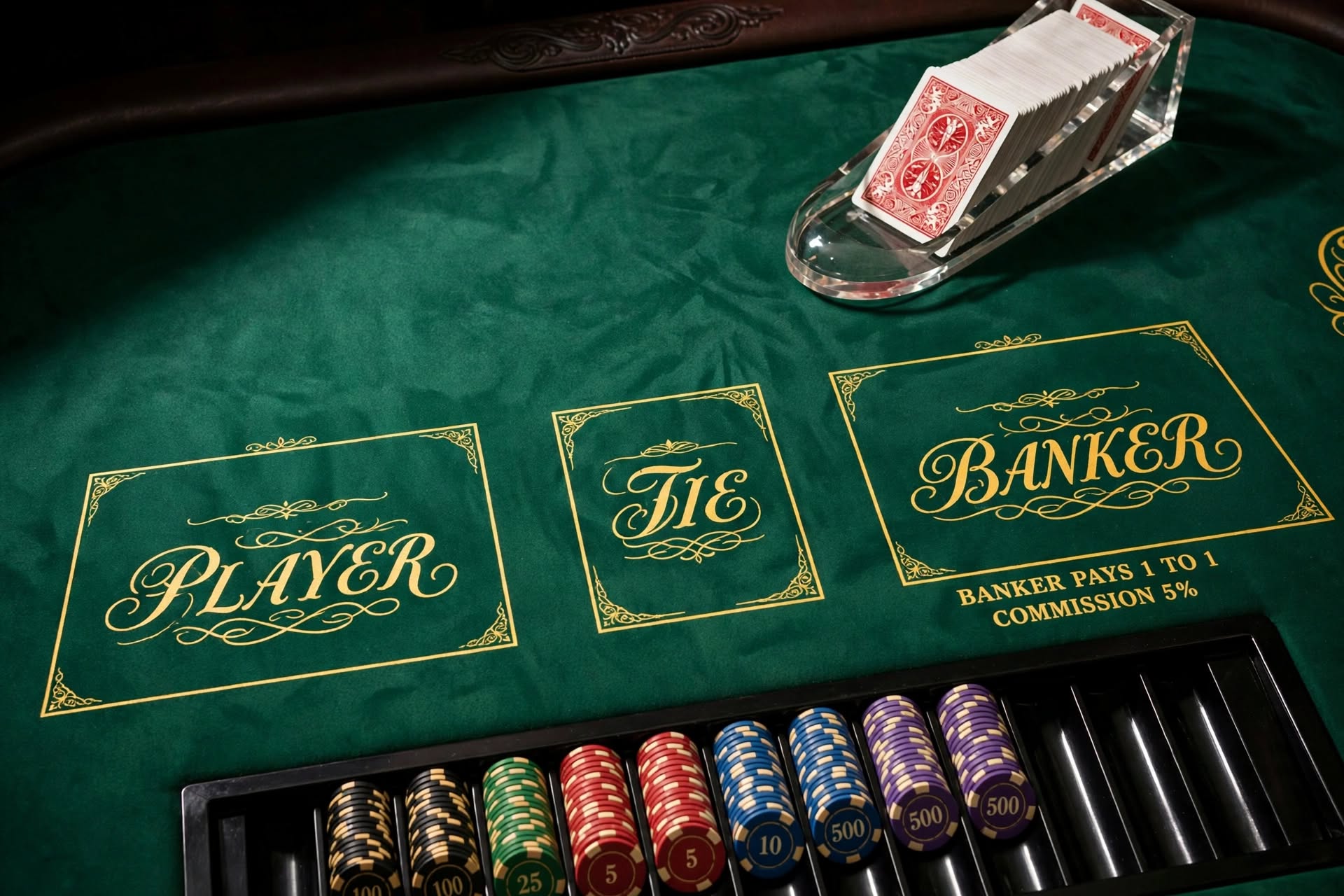
Because the Banker acts second and benefits from seeing the Player third card, the Banker wins approximately 50.68% of all non-tied hands. To offset this natural edge, traditional tables levy a 5% commission on winning Banker bets, resulting in a low house advantage of 1.06%.
Many modern resort gaming halls feature "No-Commission Baccarat" (often called Super 6 or Punto 2000). On these tables, winning Banker bets pay even money (1:1), except when the Banker wins with an exact total of six, in which case the payout is cut in half to 1:2 (paying 50%).
Mathematical Truth
While no-commission tables appear attractive by eliminating the 5% calculation, the half-pay six rule raises the overall house edge on Banker to 1.46%. Traditional 5% commission tables remain mathematically superior for long-term play. Sourced from the UNLV Gaming Studies Research.
4. Interactive Baccarat Wager & Commission Tool
Calculate expected payouts and house deductions across Player, Banker, and Tie wagers:
House Advantage
Winning Net Payout
Expected Loss / Hand
5. Side Bets & The High-Cost Tie Trap
The Tie bet pays 8 to 1 (or occasionally 9 to 1 on select Asian felt). Despite the alluring multiplier, ties occur in fewer than one in ten hands. At 8:1 payout, the house edge is an extreme 14.36%, making it one of the costliest propositions in gaming.
Common side wagers like Player Pair and Banker Pair pay 11:1 with an approximate house edge of 10.36%. Progressive dragon bets and insurance side wagers similarly introduce high volatility designed to extract higher margins than the core game.
6. The Card Squeeze Tradition
In premium baccarat salons across Macao, Las Vegas, and Singapore, the highest bettor on either side receives the privilege of slowly bending and revealing ("squeezing") the cards face down.
Players peel up the card edges horizontally to count the pips along the side (determining if the card has two pips, three pips, four pips, or a solid border), building intense ritualistic anticipation. While this ritual has zero effect on mathematical outcome, it represents one of the most celebrated cultural traditions in international gaming halls.